How traditional balsamic vinegar is made, from must to bottle
Harvest, cooking the must, the battery of casks, racking: the steps that turn grapes into Traditional Balsamic Vinegar of Modena DOP over at least twelve years.
In short
Traditional balsamic vinegar is made with one ingredient only, the cooked grape must of Trebbiano and Lambrusco grapes, and with time. The must of the late-September harvest is cooked over a direct flame in an open vessel for hours, then goes into the largest cask of a battery of casks of different woods. Once a year comes the racking: a draw is taken from the smallest cask and each cask is topped up down the line from the one immediately larger. After at least twelve years the draw is examined by a panel of master tasters from the Consortium, and only if it passes does it go into the official 100 ml bottle.
From the bunch of grapes to the bottle at least twelve years go by, and in between there are only a few gestures, repeated always the same. Traditional balsamic vinegar is made with one ingredient only, cooked grape must, and with time. Nothing added, no secret recipe: a harvest, a cauldron over the fire, a row of casks in the loft and one racking a year. Here it is in the order in which it happens with us, in Casinalbo.
What are the steps for making traditional balsamic vinegar?
The steps for making traditional balsamic vinegar are five, and they have been repeated unchanged for generations. Lined up, they take a few lines.
- The harvest. Local Trebbiano and Lambrusco grapes from certified vineyards, picked by hand at the end of September.
- Cooking the must. The must cooks over a direct flame in an open vessel for hours, until it concentrates.
- The battery. The cooked must goes into the largest cask of a row of casks of different woods.
- The racking. Once a year a draw is taken from the smallest cask and each cask is topped up down the line.
- The draw and the examination. After at least twelve years the balsamic is drawn by hand, goes to the panel's tasting and then into the bottle.
Put like that it sounds like little work, and it is true: the days of real work are few, in autumn and on the day of the racking. The rest is done by the wood and the seasons, and there is no way to speed it up: from the moment the must goes into the first cask to the moment the balsamic comes out of the last, twelve years go by, twenty-five for the Extravecchio.
Which grapes is traditional balsamic vinegar made from?
Traditional balsamic vinegar is made from the grapes of the area: with us Trebbiano and Lambrusco, from the family vineyards, picked by hand at the end of September. They are not there to make wine: what counts is the sugar in the must, not the finesse of the bunch. We harvest at full ripeness, when the grapes are loaded.
The grapes are pressed and what we want is the must, the juice before it ferments. It has to go on the fire straight away, while it is fresh: left standing it starts to ferment, and it would become something else. That is why harvest and cooking are the same day, or nearly.
Why does the must have to be cooked?
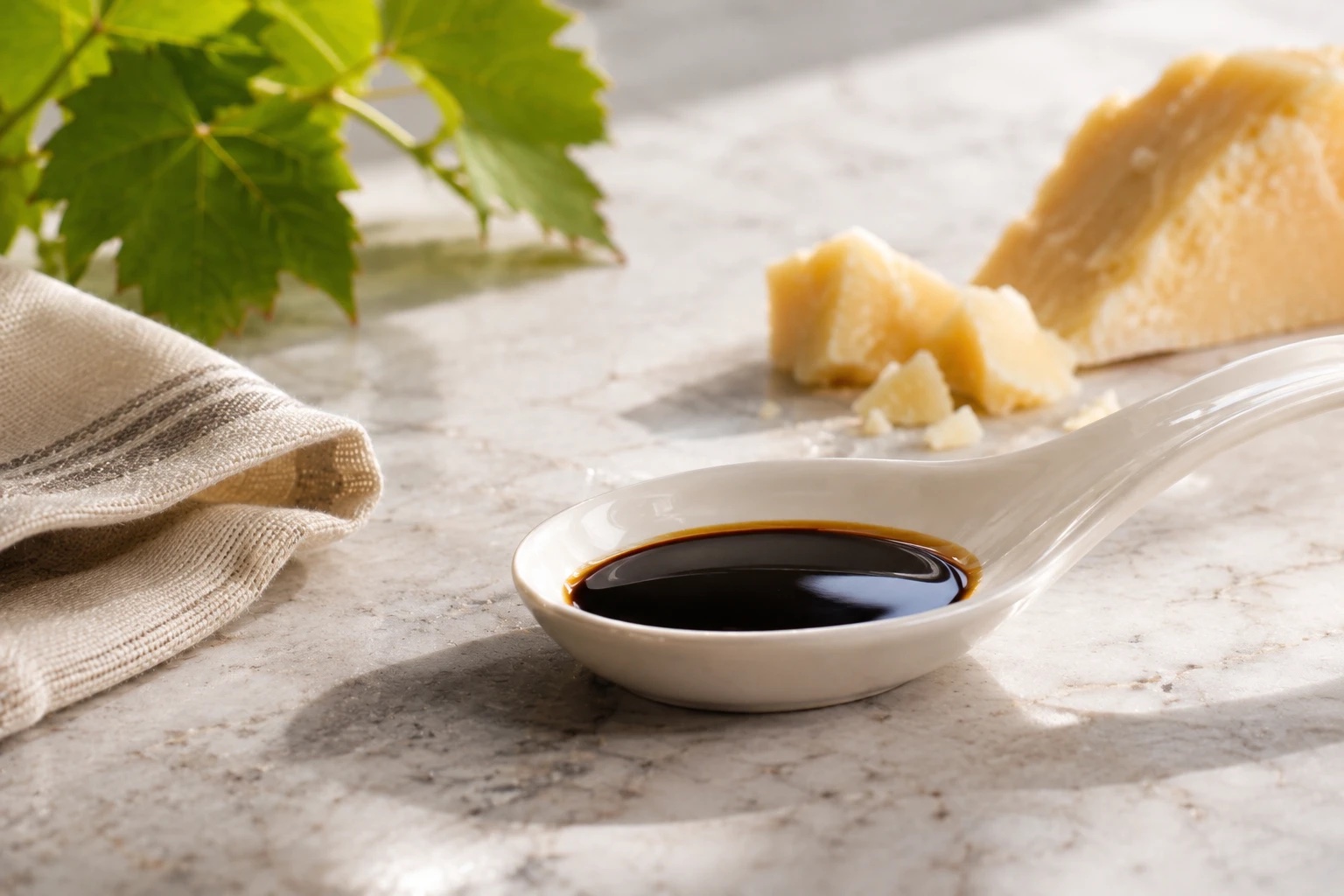
The must has to be cooked because it is the cooking that makes it into another thing, and without that step there would be no balsamic vinegar. It cooks over a direct flame, in an open vessel, for hours: the water leaves as steam and what stays behind is denser, darker and sweeter than what went in.
That reduction is not a detail. A hundred litres of fresh must give roughly half as much cooked must: it is the first of the two great losses that explain why so little Tradizionale is made. The second is evaporation in the cask, which carries on through all the years that follow.
How long it takes depends on the quantity and on the fire: there is no textbook temperature, you skim the foam, watch the colour and taste. Then the cooked must rests and goes into the battery.
What is a battery of casks, and why are the woods different?
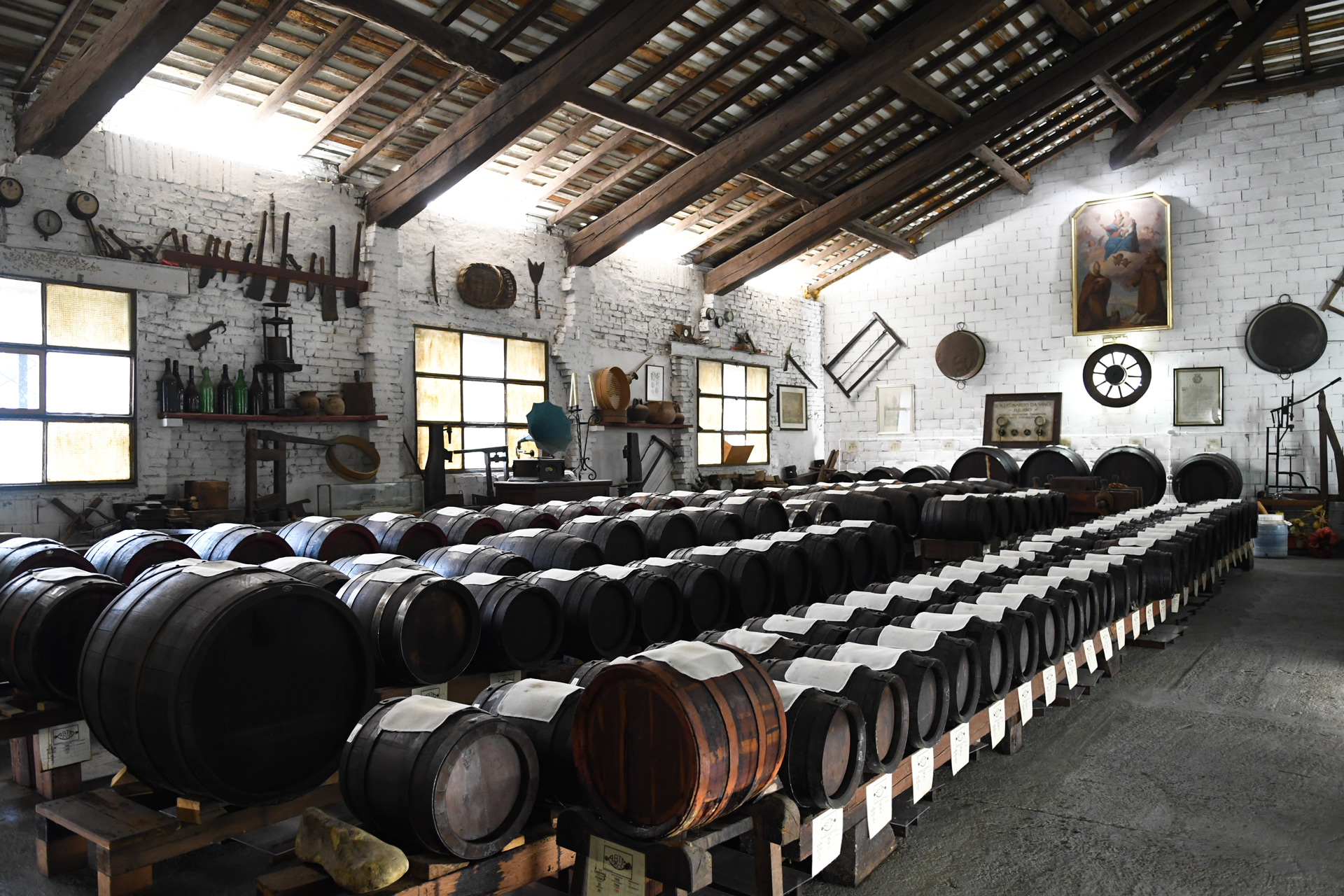
A battery of casks is a row of six casks of decreasing size, from the largest to the smallest, inside which the same balsamic moves for years. It is not one cask ageing on its own: they are casks working in a chain, and that is why in an acetaia the unit of measure is the battery, not the single cask.
The casks are not all of the same wood, and that is deliberate. In our loft there are about fifty of them, in seven different woods: oak, chestnut, cherry, juniper, mulberry, ash and acacia. Each wood leaves something of its own in the liquid that passes through it: the character of an acetaia comes partly from there.
Then there is a detail that surprises people coming up for the first time: the casks are not closed. On the top of each one there is a square opening, the cocchiume, covered only by a cloth: it lets the balsamic breathe and lets the water evaporate. A cask that is looked after lasts for decades, and ours are older than we are.
What are racking and topping up?
Racking and topping up are the work of one day a year, and they are the heart of the method: racking means moving the balsamic from one cask to the next, topping up means refilling each cask with the contents of the one immediately larger. It is done once a year only, in winter, when the liquid is still and clear, and always in the same order.
- First the draw. From the smallest cask the balsamic that is ready is taken out, and only part of what is in there.
- Then the topping up, down the line. Each cask is refilled from the one immediately larger, all the way to the first.
- Last the cooked must. Into the largest cask goes the must of the latest harvest, and the battery starts again.
From this follows something we explain at every visit: the bottle does not hold the liquid of a single vintage, it holds a blend of vintages. And there is a rule written down nowhere: you draw only what the battery can give back. Whoever takes too much has less of it the year after.
Why are the casks in the loft and not in a cellar?
The casks are in the loft, and not in a cellar, because balsamic needs swings of temperature, not a constant one. Under the roof it goes above forty degrees in summer and freezes in winter: it is that swing that makes the battery work.
In summer the heat evaporates the water through the wood and the balsamic concentrates; in winter the cold stops it, the liquid settles and turns clear. A year in the acetaia is made of those two times, and it repeats unchanged twelve or twenty-five times. It is the opposite of what wine needs, which in the cellar looks for cool and calm.
It is also the reason acetaie are not sheds but houses: our casks are in the loft of the family home, above the rooms we live in, and they have been there since 1903.
When is the balsamic drawn, and who decides it is a Tradizionale DOP?
The balsamic is drawn after at least twelve years, and deciding that it is a Tradizionale DOP is not up to us: it is a panel of master tasters from the Consortium, which examines every batch before bottling. Until that examination is passed, what we have in our hands is only the draw of a battery.
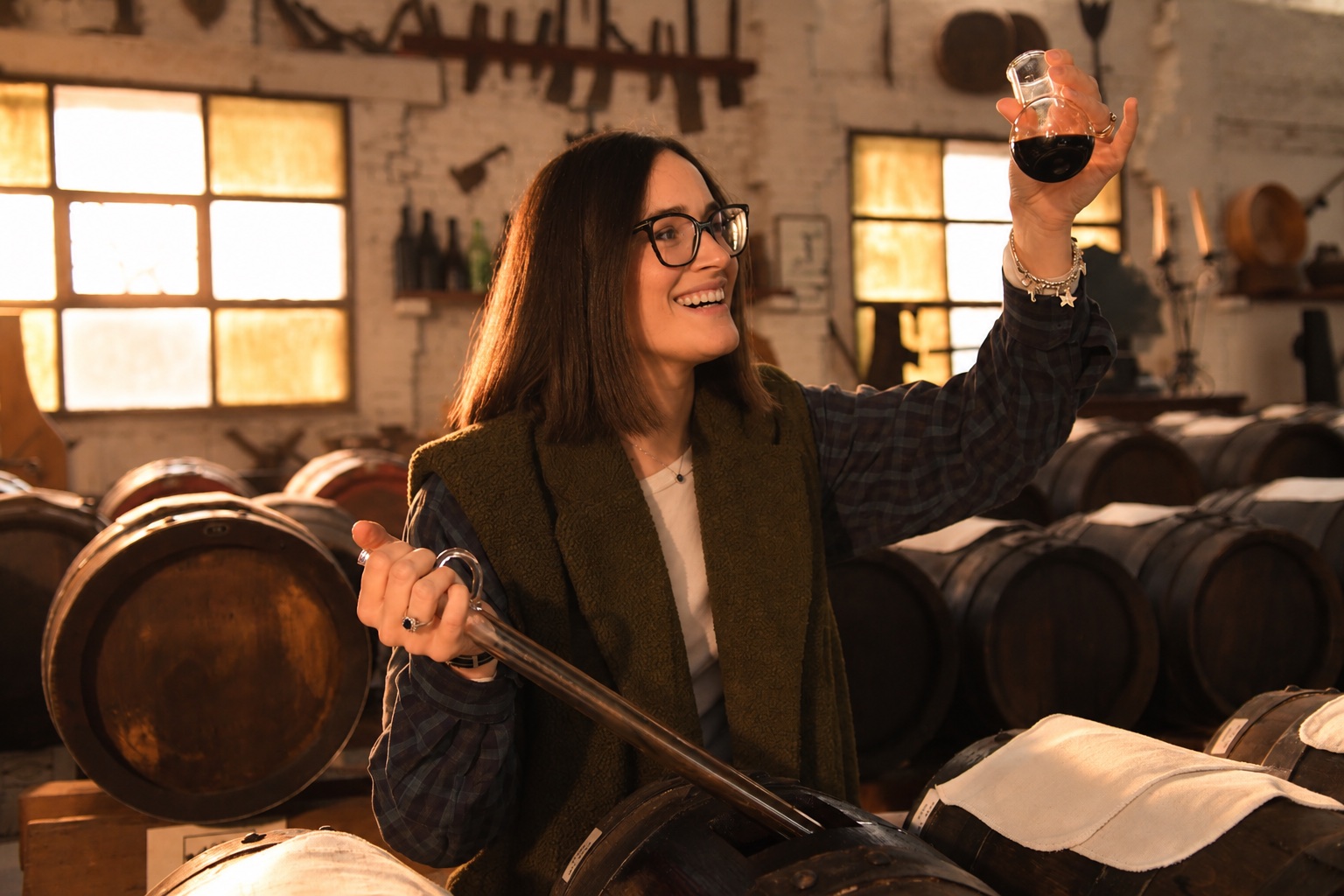
The draw is done by hand, from the smallest cask, with a glass tube, and collected in the ampoule. It is the slowest gesture of the year, and the one that tells you how it went.
Then the sample goes to the examination. The tasting is blind, and the panel assesses density, colour, aroma, acidity and persistence and gives a score. If the threshold is not reached, that balsamic cannot be bottled as Tradizionale: it goes back into the battery or takes another road.
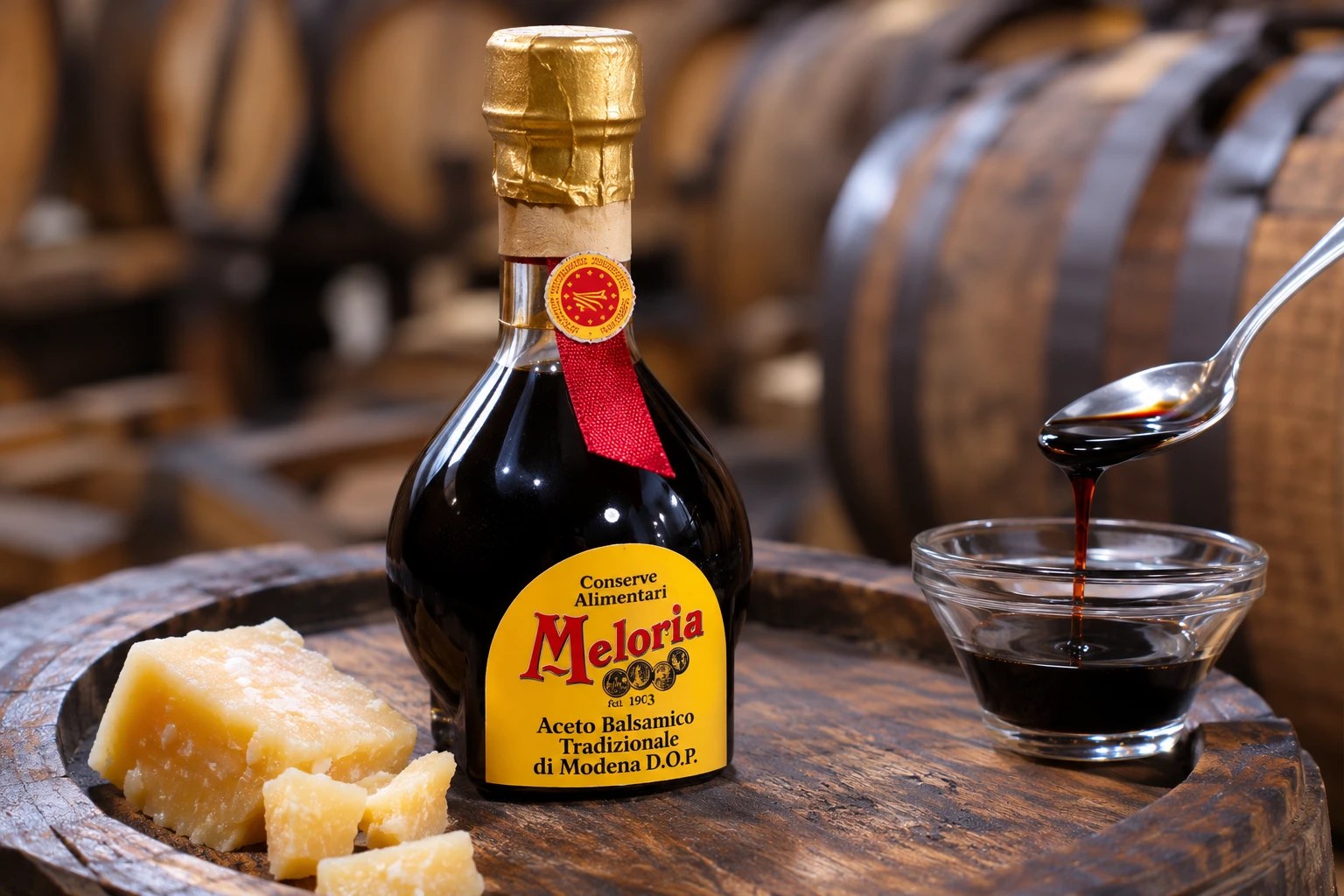
If the examination is passed, the balsamic goes into the official 100 ml bottle with the square base, the same for every acetaia, sealed and numbered. At that point the category is decided: Affinato from at least twelve years, Extravecchio from at least twenty-five. In the bottle the product is finished and ages no further.
Can you make balsamic vinegar at home?
You can make balsamic vinegar at home, but it is worth saying at once: what comes out of it is not an Aceto Balsamico Tradizionale di Modena DOP, because the denomination does not depend only on the method you follow, but on the Consortium's control and examination. It will be a home balsamic, and it can be excellent, but it goes by another name. Starting a battery, though, is something people here have always done. It takes little, and it takes a lot.
- A loft or an attic room. It has to get very hot in summer and very cold in winter: without the swings, nothing happens.
- A battery of casks in decreasing sizes, of different woods, with the cocchiume open and covered by a cloth.
- Cooked must, every year. Good grapes, cooking over a direct flame, and the constancy to do it again at every harvest.
- Patience. Twelve years go by before the first draw, and meanwhile you top up and wait.
The hardest part is none of these: it is leaving the battery alone. Home batteries are almost always ruined by too much attention, draws that are too generous or topping up at the wrong time. If the idea appeals to you, come and see a real battery before buying casks: an hour is enough to tell whether it is a thing for you.
In short
- One ingredient only: cooked must of Trebbiano and Lambrusco, picked by hand at the end of September.
- The cooking: direct flame, open vessel, hours; a hundred litres of fresh must give about fifty of cooked must.
- The battery: casks in decreasing sizes and different woods, cocchiume open, in the family loft.
- One racking a year: a draw from the smallest cask, then topping up down the line to the largest.
- At least twelve years before the draw, twenty-five for the Extravecchio.
- The Consortium's examination decides the category: only then is it bottled in the numbered 100 ml.