DOP or IGP: how to tell in ten seconds which balsamic you are holding
The bottle, the batch number, the list of ingredients: three things to check before you buy, and why the price difference is not a mark-up.

In short
Three checks tell them apart: Aceto Balsamico Tradizionale di Modena DOP is sold only in the 100 ml bottle with the square base, has a single ingredient, cooked grape must, and carries the word «Tradizionale» with the Consortium's lot number. Aceto Balsamico di Modena IGP also contains wine vinegar, comes in many formats and is aged far less: sixty days minimum, against the twelve years of the Tradizionale.
We are asked this at almost every visit: “Is what I buy at the supermarket the same thing?” No. They have almost the same name and both come from Modena, but they are two different products with two different production rules. Here is how to tell them apart at a glance.
Two almost identical names, two different products
Aceto Balsamico Tradizionale di Modena DOP is what we make: only cooked grape must, aged for at least twelve years in a battery of casks made of different woods. Nothing else.
Aceto Balsamico di Modena IGP is the far more common condiment: cooked or concentrated grape must blended with wine vinegar and aged for a much shorter time: the minimum is sixty days. It can be a good product for everyday use, but it is something else.
How they are made, in two lines
The difference is not a detail on the label: it is in what happens before. The Tradizionale starts from the must of the grapes, cooked over a direct flame in an open vessel until it reduces, and from there it goes into a battery of casks of different woods: oak, chestnut, cherry, ash, mulberry, juniper. Every year a part of it evaporates and it is racked from the larger cask into the smaller one. After twelve years, in the smallest, there is the balsamic.
The IGP comes about in another way: cooked or concentrated must blended with wine vinegar, often with a small percentage of aged vinegar and, if the label declares it, caramel for the colour. The result can be made in two months. It is not a swindle, it is an industrial product meant to cost little and end up on a salad; the problem starts when it is sold made to look like the other one.
1. Look at the bottle
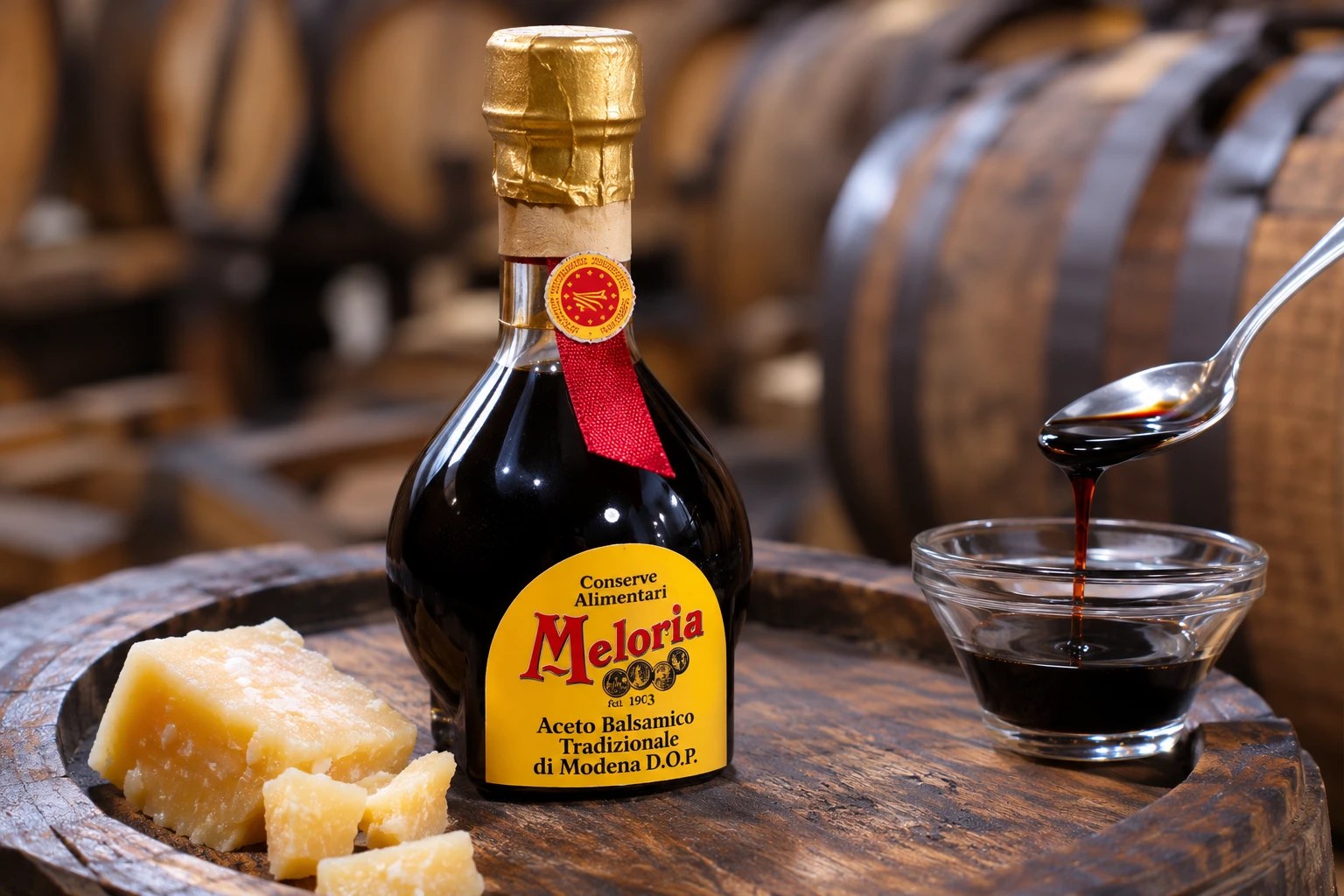
Traditional Balsamic Vinegar of Modena DOP is sold in one bottle only: the rounded 100 ml bottle with a square base, the same for every acetaia. There are no half-litre bottles or sprays of Tradizionale. If the format is different, it is not a Tradizionale DOP.
2. Read the ingredients
On a Tradizionale DOP you will find a single ingredient: cooked grape must. If the label lists wine vinegar, concentrated must, caramel or thickeners, you are holding a condiment or an IGP.
3. Look for the word “Tradizionale” and the batch
The full name is “Aceto Balsamico Tradizionale di Modena DOP”. Every batch is tasted by a panel of master tasters from the Consortium before it can be bottled, and the bottle carries its number. “Extravecchio” means it has been aged for at least twenty-five years.
Why it costs so much
Traditional balsamic vinegar costs what it costs because of the time it takes, not because of a mark-up. The cooked must goes into the largest cask and, racking after racking, moves down towards the smallest, losing water every summer. After twelve years, a hundred litres of must leave only a few litres of balsamic. Every bottle we draw today was put into the cask by those who came before us.
That is why it is used by the drop: a 100 ml bottle gives 60 to 100 servings and lasts for months, sometimes more than a year.
Who checks that it is the real thing
With the Tradizionale you do not have to take anyone's word for it. Every batch goes through the Consortium: a panel of master tasters tries the sample blind and scores it on density, aroma, acidity and persistence. If the score does not reach the threshold, that balsamic cannot be bottled as Tradizionale and goes back into the battery, or takes another road.
Only after the examination is the product bottled in the official bottle, sealed and numbered. That is why bottles of Tradizionale are the same all over Italy: the acetaia and the label change, the glass does not. For the IGP checks exist too, but they are mostly about composition and traceability, not a tasting batch by batch.
Labels that look like something they are not
In the shop, the confusion almost always comes from three words. “Condimento”, the Italian label term for a free-form seasoning: it follows no production rules and can contain anything; some are excellent, but they are neither DOP nor IGP. “Invecchiato” or “riserva” on their own: on an IGP they do not indicate a number of years guaranteed by anyone. “Modena” written large: it says where it was produced, not what is inside.
The quickest check is still the ingredients. A single ingredient, cooked grape must, and the word “Tradizionale” written out in full: that is the only case in which you are holding a DOP. Everything else, however good, is another category.
How long it really ages: 12 and 25 years
The Tradizionale DOP comes in two versions. The Affinato is at least twelve years old and is recognised by its cream-coloured seal; the Extravecchio is at least twenty-five and carries the gold seal. This is not a matter of labelling: they are two different products on the palate, the first livelier and sharper, the second denser, sweeter and longer in the mouth.
In the IGP, on the other hand, no ageing beyond sixty days is required. Some producers do age it in wood and say so on the label, and those are honest products; but between sixty days and twelve years the difference is plain to taste.
When to use one and when the other
The Tradizionale DOP always goes on raw, at the end of cooking: on parmigiano, on meat just off the grill, on a slice of pear, on ice cream. Heating it is a waste: the heat carries off the aromas that took twelve years to make.
The IGP and the condiments are made for everything else: salads, marinades, reductions, caramelised onions. Everyday cooking, in other words. The two bottles do not replace each other; they both belong in the pantry.
How to read the price
In a shop the IGP costs from a few euros to about twenty; the Tradizionale DOP starts at €40–50 for the 100 ml bottle of Affinato and rises with the years. If you find a “traditional” for a few euros, it is not a bargain: it is a different product, and almost always the word “Tradizionale” is missing, or written so as to look like it.
And our advice, from the people who make it
At the acetaia we never say the IGP should be thrown away: both bottles have their place in the pantry, each in its own role. What we are sorry to see is someone buying an IGP believing they are taking home a Tradizionale, and then being disappointed by a product that could never have given them what they expected.
If you have a gift to make, or you want to taste the real difference once, take the Tradizionale and use it by the drop. If what you need is the everyday bottle for a salad, buy a good IGP and do not spend too much. What matters is knowing which of the two you are holding, and that is exactly what you can see in ten seconds by looking at the bottle, the ingredients and the label.
In short
- 100 ml bottle, always the same: Tradizionale DOP.
- A single ingredient, cooked grape must: Tradizionale DOP.
- Wine vinegar or caramel among the ingredients: IGP or condiment.
- Cream seal twelve years, gold seal twenty-five years.
- Tradizionale raw, IGP for everyday cooking.