How much traditional balsamic vinegar of Modena costs, and why
From a few euros to more than a hundred: what lies behind the price of a 100 ml bottle, and how to recognise a fair price.
In short
Aceto Balsamico Tradizionale di Modena DOP costs €40 to €60 for the 100 ml bottle of Affinato, twelve years, and €70 to €120 for the Extravecchio, twenty-five years. The price comes down to two things: evaporation, because after twelve years a hundred litres of cooked grape must leave only a few litres of balsamic, and time, because the bottle we sell today was put into the cask by a previous generation. Aceto Balsamico di Modena IGP costs €3 to €20 for half a litre because it is made in sixty days and is another product.
It is the question that always comes, usually half under the breath, in front of the bottle: “But why does it cost that much?” It is a fair question, and the answer is not “because it is handmade”. The price of the Tradizionale is explained by two numbers: how much must evaporates and how many years go by. Everything else follows from those.
Balsamic vinegar: IGP and DOP prices compared
Balsamic vinegar prices run from a few euros to more than a hundred, and the difference is not the brand: they are two different products. These are the figures you normally find in a shop.
- Aceto Balsamico di Modena IGP: from €3 to €20 for half a litre, depending on the percentage of must and on the ageing declared.
- “Condimenti” and glazes: from €4 to €15, various formats. “Condimento” is the Italian label term for a free-form seasoning: it follows no production rules.
- Tradizionale DOP Affinato, twelve years: from €40 to €60 for the 100 ml bottle.
- Tradizionale DOP Extravecchio, twenty-five years: from €70 to €120 for the same 100 ml bottle.
With us the Affinato is €49 and the Extravecchio €79, presentation box included. If you find a “traditional” at €10, it is not a bargain: it is another product, and almost always the word “Tradizionale” written out in full is not on the label.
Why a 100 ml bottle costs 79 euros
A 100 ml bottle costs 79 euros because filling it took twenty-five years and an amount of must that nobody imagines today. The arithmetic goes like this.
It starts with the grapes. Trebbiano and Lambrusco, harvested at the end of September. The must is cooked over an open flame in an open vessel for hours, until it has lost much of its water: already here, a hundred litres of fresh must give about half as much cooked must.
Then the evaporation begins. The cooked must goes into the largest cask of the battery and every year, in summer, a part of it leaves through the wood. Every year it is racked: the large cask tops up the one immediately smaller, and so on down to the last. After twelve years, a hundred litres of cooked must leave only a few litres of balsamic; after twenty-five, fewer still.
Finally there is time, which cannot be bought. The bottle we draw today was put into the cask by those who were here before us. No acetaia can increase production because demand is growing: what comes out of the smallest cask is what there is, and to have more of it you had to think of it twenty-five years ago.
To this are added less romantic but very real things: the casks, which cost money and have to be maintained for decades; the Consortium's examination batch by batch; the official bottle, the same for every acetaia, with its seal and its number.
How long a bottle lasts, and what it costs per serving
Looking at the price of the bottle is the wrong way to look at it: the Tradizionale is used by the drop, and a 100 ml bottle gives 60 to 100 servings. Do the sum, and the €79 Extravecchio costs between €0.80 and €1.30 a serving, the €49 Affinato between €0.50 and €0.80.
Less than a coffee at the bar, for something twenty-five years old. And it lasts: opened and kept in the pantry, a bottle stays good for months, often more than a year, because traditional balsamic vinegar does not expire, not even after opening.
It is also the reason why, when someone tells us it is expensive, the question we ask is a different one: how often do you think you will use it? If the answer is “every day on the salad”, then what you need is a good IGP, not the Tradizionale. If the answer is “on the parmigiano, when someone comes to dinner”, then you are looking at about a euro each time.
The most expensive balsamic vinegar: what makes it so
The most expensive balsamic vinegar is the one that has stayed longest in the battery, and there is not much else to it. Beyond the twenty-five years of the Extravecchio there is no official category: some acetaie bottle draws from batteries of fifty or a hundred years and sell them at two hundred euros and more, but on the label they remain “Extravecchio”, because the production rules stop there.
Other real things weigh on the price too: the yield of the battery, which changes from acetaia to acetaia and from year to year; the score at the examination, because a strict panel rejects the batches that do not reach the threshold; the size of the acetaia, because two thousand bottles a year do not allow the economies of an industrial production.
What should not weigh is marketing. A more elaborate package, a grand-sounding name or a “limited” edition do not change what is in the bottle: in the Tradizionale the glass is the same for everyone and the only ingredient is cooked must. If the price goes up, it has to go up for the years.
How to tell whether a price is fair
Three checks are enough, and they take ten seconds in the shop.
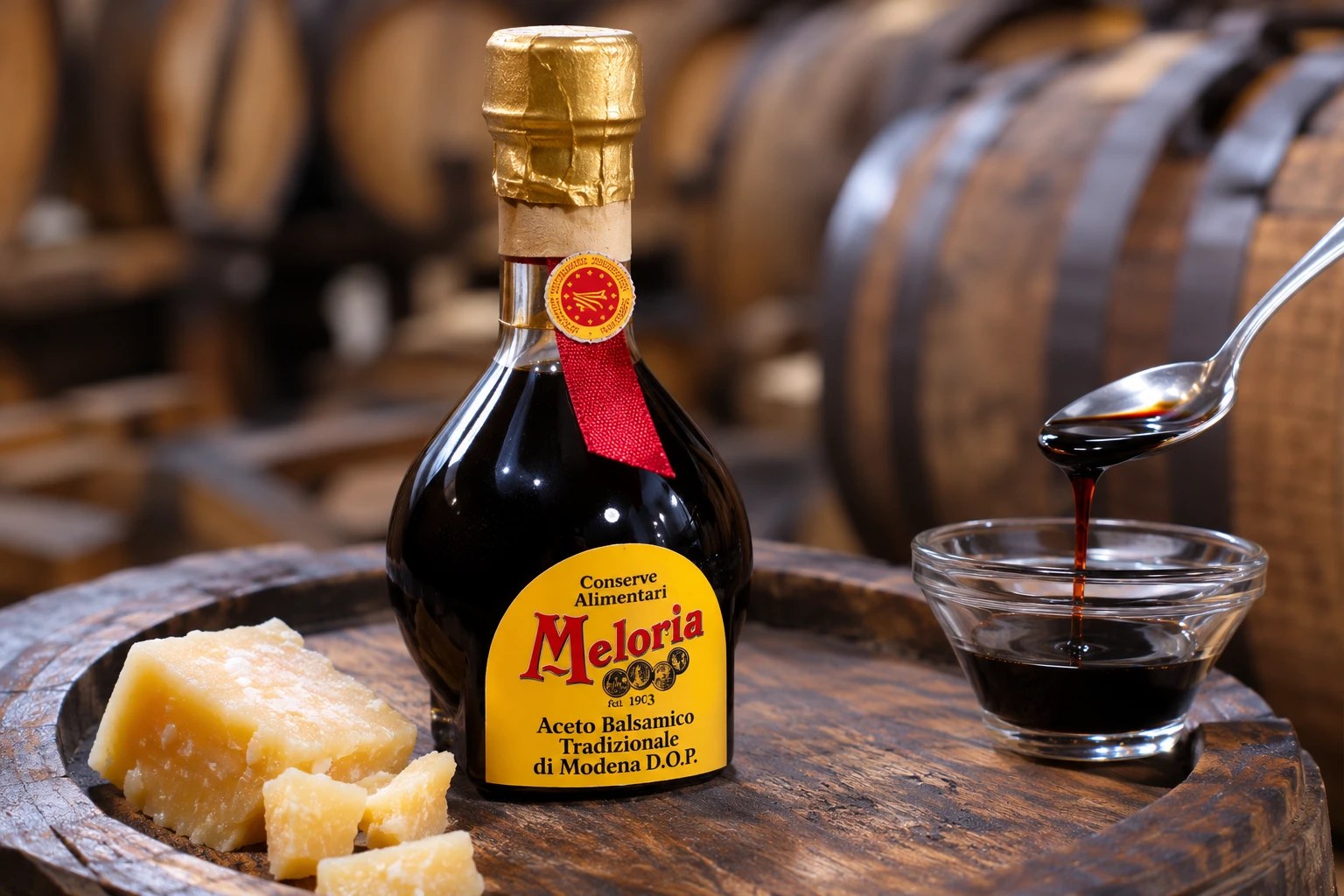
- The format. The Tradizionale exists only in the 100 ml bottle with the square base. A high price on a different format is a high price on another product.
- The ingredients. One ingredient only, cooked grape must. If wine vinegar or caramel appear, the price of a Tradizionale is not justified.
- The wording and the seal. “Aceto Balsamico Tradizionale di Modena DOP” written out in full, cream-coloured seal for the Affinato and gold for the Extravecchio, with the bottle number.
If these three things are there, a figure between €40 and €120 is normal, and within that range the difference is made by the years and by the acetaia. If even one of the three is missing, any figure above twenty euros is too much.
Where to buy traditional balsamic vinegar in Modena
The safest way to buy the Tradizionale is to get it directly at the acetaia: you taste before choosing, you see the battery it comes from and you talk to the people who make it. In and around Modena there are many acetaie open to visitors, almost all by appointment, because they are family houses, not factories.
We are in Casinalbo di Formigine, ten minutes from Modena on the road to Maranello. Visits are by appointment: you go up into the loft among the batteries and at the end you taste the Affinato and the Extravecchio from the spoon, which is the best way to understand, before spending, what the difference between the two is.
If Modena is far away, you buy online, here on the site as well, with shipping in Italy and in Europe. In that case it is worth checking that the seller is the acetaia itself or a declared reseller, and that the product page shows the full wording and the 100 ml format.
In short
- Affinato, twelve years: €40–60 for 100 ml; €49 with us.
- Extravecchio, twenty-five years: €70–120 for 100 ml; €79 with us.
- IGP: €3–20 for half a litre. Another product, another use.
- Per serving: between €0.50 and €1.30, because a bottle gives 60–100 servings.
- A fair price: 100 ml format, one ingredient only, full wording and seal.