Does balsamic vinegar expire? How to store it, even after opening
Tradizionale DOP, IGP and glaze do not age in the same way: what the label says, where to keep the bottle and when to worry.
In short
Aceto Balsamico Tradizionale di Modena DOP does not expire: by law vinegars do not even need a date on the label, and the bottle keeps in the pantry, upright and away from light, even after opening. Aceto Balsamico di Modena IGP usually carries a best-before date chosen by the producer; after that date it loses aroma but does not become unsafe. Balsamic glaze, which contains sugars and thickeners, does have a real date and should be used within a few months of opening.
It is the question we are asked most often after the holidays: a bottle received as a gift years earlier turns up at the back of the cupboard, and nobody knows whether it is still good. The short answer: balsamic vinegar does not go off the way yogurt does, and in most cases that bottle is still perfect. But “it does not expire” is not the same as “it does not change”, and between Tradizionale DOP, IGP and glaze the differences are considerable.
Does Aceto Balsamico Tradizionale di Modena DOP expire?
No: Aceto Balsamico Tradizionale di Modena DOP does not expire, and by law it does not even have to carry a date. The European regulation on food labelling exempts vinegars from the best-before date, along with wine, salt and sugar: because of their acidity, these products do not become dangerous over time.
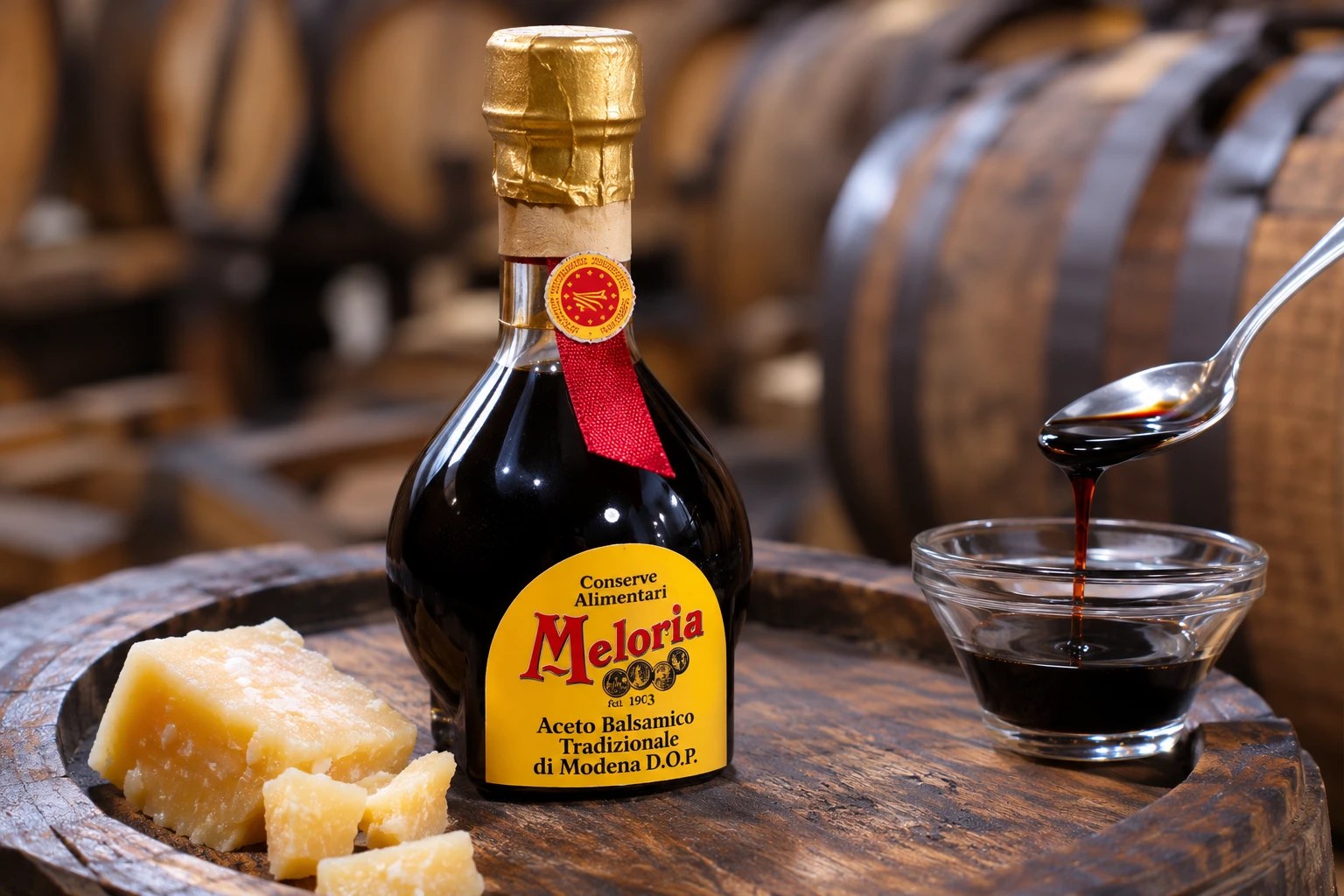
In the Tradizionale DOP there is one ingredient only, cooked grape must, aged for at least twelve years in casks. It is dense, acidic and sugary all at once: an environment in which the micro-organisms that spoil food cannot live. An unopened bottle can sit in the pantry for years without a problem.
The taste does change, though, and not for the worse. Inside the bottle the balsamic slowly goes on concentrating: it becomes a little denser and a little darker. Anyone who opens a bottle forgotten for ten years usually finds a product rounder than the one they were given.
Does balsamic vinegar expire after opening?
No, traditional balsamic vinegar does not expire after opening either. Once opened, the bottle only needs to be closed properly and put back in the pantry: the fridge is not necessary. Given how it is used, a few drops at a time, a 100 ml bottle lasts for months, often more than a year, and it does not spoil in the meantime.
The one thing to watch is the cap: left open, the balsamic dries out and a sugary crust forms on the neck. It comes off with a damp cloth.
Aceto Balsamico di Modena IGP: the best-before date
On the IGP, which is a different thing, you will often find a date: “best before”. It is not a legal obligation but the producer's choice, and it indicates the period within which they guarantee the product at its best, usually three or five years.
Past that date the IGP does not become dangerous: it may lose aroma, darken, sometimes separate slightly. You can still use it, perhaps in cooking rather than raw. But if the smell is as sharp as wine vinegar and the sweetness has gone, it is time to replace it.
Balsamic glaze after opening
The glaze is the odd one out of the three, because it is not only vinegar: it contains sugars and thickeners, so it always has a date on the label and should be treated like a sauce. Tightly closed, in the pantry, it keeps until the date shown; after opening it keeps at room temperature with the cap closed, and is best used within a few months.
Always check the label on your own bottle: every producer states their own conditions, and for glazes they vary from brand to brand.
How long does balsamic vinegar last after the date?
It depends which of the three you are holding. The Tradizionale DOP has no date to go past: the bottle stays good for years, opened or not. The IGP can safely be used a year or two after the date shown, as long as the smell is still right: it does not become dangerous, it simply loses its edge, and at that point it works better in cooking, on an onion or in a reduction, than raw on a salad.
The glaze is the only one to be careful with: past the date it can separate, thicken too much or change smell. If the date is long gone, better to replace it.
Where is the expiry date on balsamic vinegar?
The date, when there is one, is on the back of the label or printed on the glass near the bottom, usually next to the batch number and preceded by the words “best before”. On small bottles it is sometimes stamped on the neck or on the cap.
On the Tradizionale DOP you will not find those words: in their place are the bottle number and the Consortium's lot number, which trace the battery of casks and the year of bottling, not an expiry date.
Where to store the bottle: three rules
Our casks sit in the loft, where the summer goes past forty degrees and the winter freezes: it is exactly that swing in temperature that keeps the balsamic working, year after year. But what the cask needs is not what the bottle needs. Once bottled, the balsamic has finished its work and asks only to be left in peace.
At home almost everyone already has the right spot without knowing it: the pantry, or a closed cupboard away from the hob. You do not need a cellar and you do not need a precise temperature. What you need is darkness, a temperature that does not keep jumping about, and the bottle standing upright.
- Upright, not lying down. Balsamic is dense and sugary: prolonged contact can ruin the cap.
- In the dark and away from heat. The pantry is perfect; the windowsill above the hob is not. Direct light and swings in temperature are the only real enemies.
- No fridge. The cold makes it more viscous and mutes its aroma. The same goes for the glaze, which keeps at room temperature.
One last thing about the packaging: the presentation box is not just gift wrapping, it is the simplest way to keep the bottle in the dark. If the bottle is going to stay in the pantry for months, put it back in its box between one use and the next.
Is sediment at the bottom a fault?
No, sediment at the bottom is not a fault. In a bottle that has stood still for a long time a veil or a small deposit may appear at the bottom: these are natural substances of the must settling. It is not mould and it is not a sign of a spoiled product. Just move the bottle gently before using it, or pour without taking up the sediment.
What to watch for is something else: a smell that stings instead of being fragrant, a colour turned cloudy, a flat taste. In the Tradizionale DOP this practically never happens. If it should happen to one of our bottles, write to us: we want to know.
Why balsamic vinegar needs no preservatives
Balsamic vinegar keeps on its own for two reasons that work together. The first is acidity: in an acidic environment the bacteria that spoil food cannot multiply. The second is the concentration of the sugars of the cooked must, which holds on to the water and makes it unavailable to moulds and yeasts. It is the same principle as honey and jam, which is why they last for years.
In the Tradizionale DOP both factors are at their highest, because twelve years of racking have evaporated much of the water it started with. That is why there is no preservative on the label: it would serve no purpose. In the IGP the acidity is there but there is more water, and that is exactly why producers prefer to state a date.
How to tell whether it is still good
Three checks, in this order. The look: balsamic should stay glossy and dark; a cloudy liquid, or one with patches on the surface, is suspect. The smell: it should be sweet and winey, not sharp like salad vinegar. The taste: a drop on the back of the hand should give sweet and sour together; if it is only sour, or flat, the product has lost what it had.
In the Tradizionale DOP these problems practically never come up, which is why a bottle received as a gift can be kept aside for the right occasion without any hurry.
If we may give one piece of advice, though: the right occasion is sooner than you think. At the acetaia we often hear that the bottle is still unopened after five years, kept there for a special day. It does not spoil, that is true. But it is made to be used, a few drops at a time, on what you eat every day: a shaving of parmigiano, a piece of meat, even a strawberry.
In short
- Tradizionale DOP: no expiry, not even after opening. In the pantry, upright, in the dark.
- IGP: usually a “best before” date. After that you can still use it, but it loses aroma.
- Glaze: has a real date. Once opened, use it within a few months.
- Fridge: not needed, not even for the glaze.
- Signs to check: cloudy look, sharp smell, flat taste.